


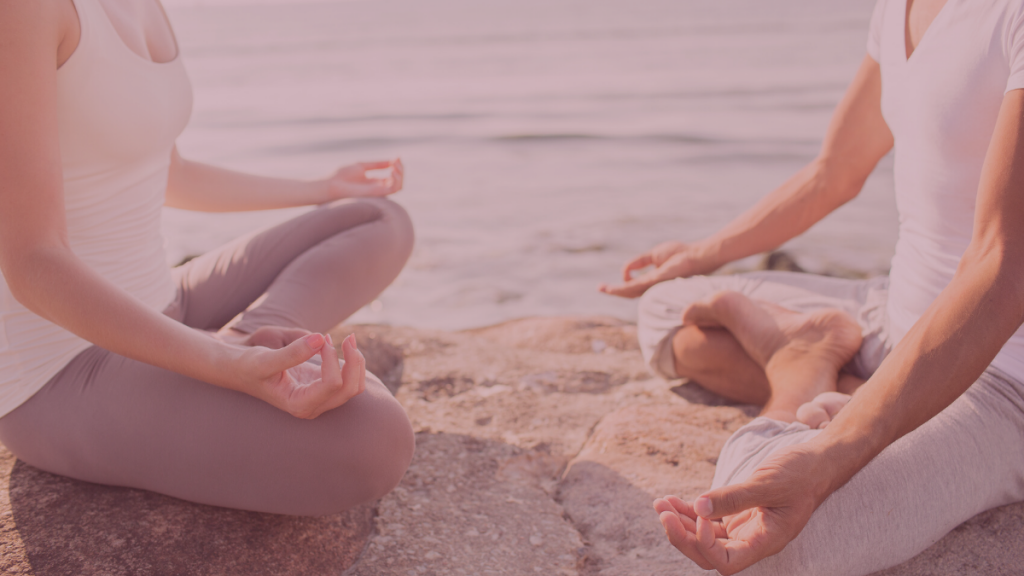
Interested in yoga? Wanted to start for ages? And just not “got around” to it? Is this because you are holding on to some pre-conceived ideas that stop you giving it a try?
To help you along the way, here are my top 5 yoga myths for beginners broken down for you.
To try something new and out of your comfort zone, requires effort but with it comes a possible new experience. You may love it, you may not. Without a try you will never know.
1. Is Yoga a religion?
No, there is certainly no religion called Yoga. And Yoga does not need you to believe in any God or Goddess to practice. To understand why this myth exists then we need to look at the origins of yoga.
There is a deep, rich and ancient history to yoga that comes from Ancient India (which included our modern countries we know as Bhutan, Burma, Pakistan, Afghanistan and Nepal) more than 5000 years ago.
It’s teachings and practices were born out of the culture and society of that time. The language of yoga therefore is Sanskrit and the major schools of yoga that made it the West were all influenced by the philosophical frameworks of Buddhism and Hinduism.
This is why we have the reference to Hindu deities and mythology weaved into some practices.
It is Indian
Yoga in its origins is Indian, and it is important to note that it was developed to answer the questions of most spiritual journeys in the whole of history – Who am I ? and Why am I here?
In this way, it can be understood as a complete system of self-realisation which includes physical postures, breath, meditation, that lead into subtle practices for self-reflection and ultimately an altered state of consciousness.
Modern yoga today is therefore just one branch of the full yogic system – the physical practice of asana (postures). There is a term within the wider yoga community for this – Modern Postural Yoga (MPY) to differentiate from the broader understanding of yoga as a complete scientific approach to living.
MPY today is influenced by many other schools such as the world of modern science, anatomy and physiology. It is informed by lots of complimentary practices such as resistance training, gymnastics, tai chi, qigong and ballet.
The key to the practice of yoga regardless of school, lineage or approach is – the awareness with which you are practicing and the skill of presence you can apply to your time on your mat.
Certainly in my teachings I encourage an introspection to feel the effects of the practice itself, to centre, re-ground and balance against the challenges of life. This sounds so simple, but is not always the case. A life-long practice in itself.
2. Yoga is just for the flexible
Ofcourse yoga helps our flexibility but the practice of yoga is not just a set of stretches. It is an ancient science to master our inner energy and feel a state of wellness that we can harness when we most need it and can return to.
A regular yoga practice also has many health benefits that stretch (no pun intended) far beyond touching your toes. The benefits include improving your posture, overall health of the skeletal system for your spine and major joint health. It’s energising & nourishing, manages your emotional response including stress/anxiety and promotes better sleep by calming the nervous system.
3. Yoga is too girly
There are over 2 billion people practicing yoga globally, and this is growing year on year.
Yes, there are still more women than men but this is changing with more men wanting to compliment their fitness with less-intensive training. The key to overall wellness is a well-rounded approach to our health.
The ways yoga can specifically help men is increasing your mobility and overall range of motion. Repetitive exercises and workouts in the gym where core muscle groups are targeted will in time, restrain the range of motion in your joints as these muscle groups shorten.
Yoga will help to lengthen these and the underlying connective tissue and increase blood flow.
4. Yoga is not really a workout
This is another one that boys that are gym-goers believe, somewhat naively or a self-preservation mechanism maybe?
The truth is like anything else in life, it will be exactly how you want it to be. Just as you can be lack-lustre in the gym or a fitness class – going through the motions – you can do the same in yoga.
Yoga uses our own body weight and natural resistance to gravity so it is as much a challenge as you decide. Your whole body is your weights if you use it and then your cardio is done through your breath practice. The more efficient we can make our breath, the more effective our practice.
Returning to the goals of yoga in its broadest sense – as a holistic system – the yogis wanted their body to be strong, resilient and healthy so they can focus on more advanced meditation-based practices without distraction from a weak body.
5. Yoga isn’t for me
This may be the case if you are thinking only of MPY.
There are many different forms of yoga that each have their own focus, so it is worth exploring and there may be a class that fits you.
For active classes centred around physical strength, you will find power yoga, dynamic flow as well as slower more strength building like hatha, slow flow or sometimes just titled yoga.
Complimentary classes like yin yoga which is slow and stretchy (one of my personal favourite styles to teach) or restorative which is stress relieving & look at yoga as a mind-body practice. Meditation classes are also an important part of Yoga which are non-physical and help us to switch off and recharge.
To learn more teaching style & methodology, see my online classes and try your first class for free by joining my newsletter